
Getting Wet
Ponds and Rivers
Of the wide variety of ponds in Hampshire, many were created or adapted to serve a particular need. The trouble now is, who needs a pond to soak cartwheels in, or to provide for livestock when a trough can be supplied from mains water? If left alone, pondweeds, reeds, and trees may grow into a pond, filling it with decaying vegetation. A damp hollow in the woods may be the final result. Many species of plants and animals live in and around ponds, some requiring open water, while others need the relative safety of dense vegetation.
In an ideal world, ponds could be left to go through their natural succession, eventually reverting to dry land. Rather than maintain one pond in a specific state, you could dig a succession of others nearby. This assumes that the land is available and isn't already valuable for something else. In reality, most ponds are maintained by pulling out growth and by occasional digging. The general rule is only to clear about one third of the pond in a year, to avoid wiping out populations of plants or animals.
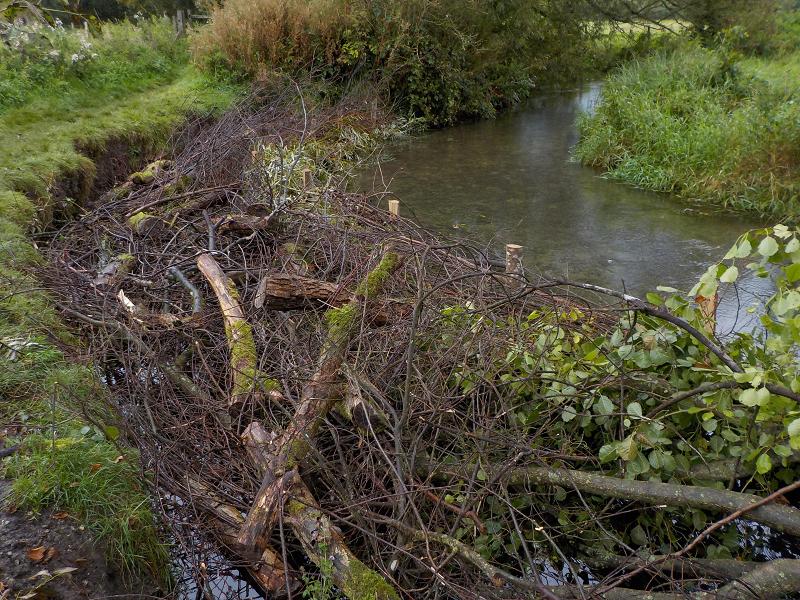
Usually rivers and streams are left to be as natural as possible, though excessive erosion of a bankside can be reduced with some carefully placed revetments. This may consist of a few stakes with cut material behind, which slows the water down and allows vegetation to regrow on the bank and in the water. Fast-growing trees such as willow may then be planted along the bank.
Water Meadows
Working water meadows are now a rarity. They were a traditional
method of improving yields from grasslands next to rivers by
controlled flooding in winter. The meadows were less likely to
freeze in winter than other fields, and gave an 'early bite' for
the sheep. It was a very labour-intensive system with men known
as 'drowners' permanently employed to maintain the system. The
network of channels had to be dug out regularly to ensure the
correct distribution of water over the meadow. Any low point on
the side of a feeder channel sent water off too soon. The
action of the water during the winter, and the movement of the
sheep during the summer, both tend to flatten out the ground.

We have worked on the water meadows at Ovington, near Alresford, for many years. Although derelict systems can be found at various places along Hampshire's rivers, the meadows at Ovington are the largest working area in the county.
Of recent times the meadows have become an important refuge
for water voles. Their most infamous predator is the mink, but
tends to keep to the main river courses. The channels are also
used by water shrews, grass snakes, toads and various invertebrates, and act as
a nursery for fish fry. Redshank and Snipe may nest in summer. In
their hey-day the water meadows might have been regarded as
intensive farming, with two cuts of hay in the summer, and this
did not particularly favour the greatest variety of plant life.
Today the management is more relaxed, and the meadows are now
home to plants and animals which have been lost from the
surrounding countryside.